Samsung Odyssey G7 Review: 1000R Curved Gaming
The Odyssey G7 made 1000R curvature and 240Hz mainstream at once — years later its spec sheet still holds up, with one flicker footnote.
By Sofia Marques · October 17, 2026 · Updated October 17, 2026
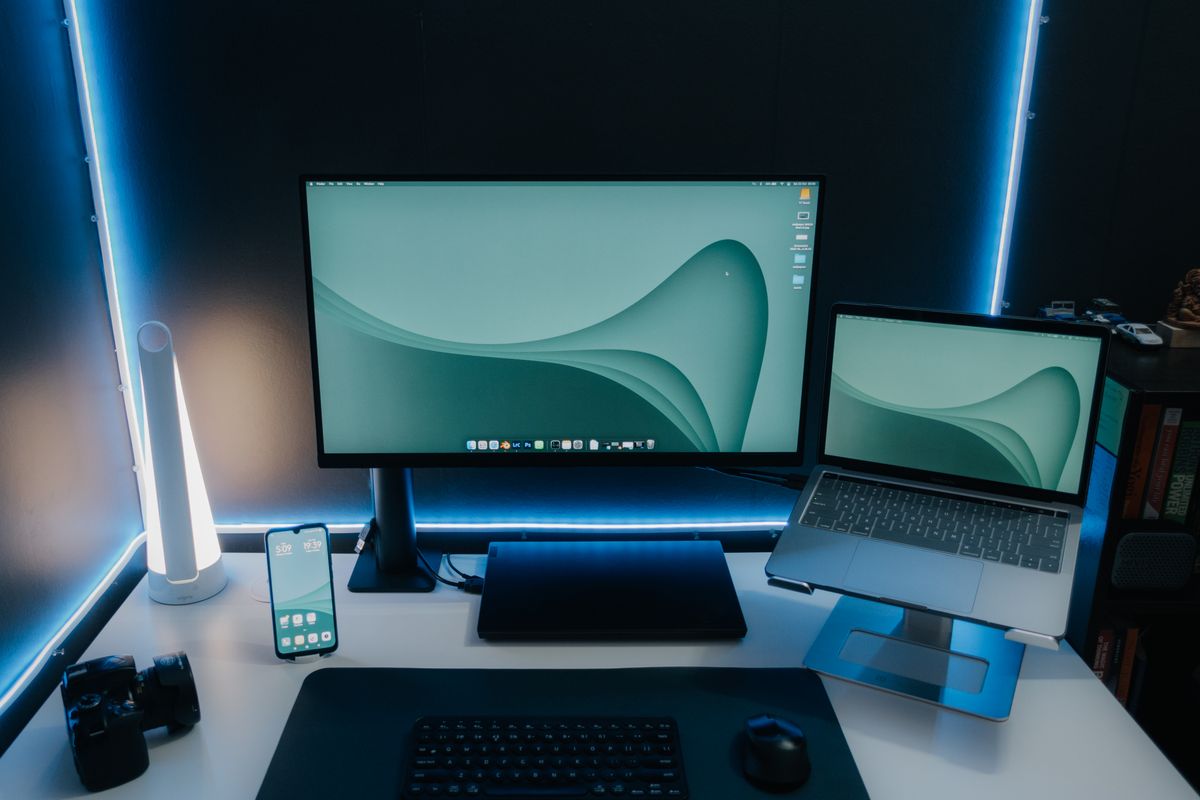
Few monitors changed the market’s defaults like the Samsung Odyssey G7. In one generation it made 1000R curvature, 240Hz, and DisplayHDR 600 the template for mid-range gaming displays, at a launch price of $599.99 for the 27-inch LC27G75T. It has since drifted well below that at US retailers — RTINGS currently lists it around $499.99 — and the panel design it pioneered is now everywhere, the best evidence of how well the formula landed.
The 1000R experiment that worked
Samsung wrapped a 27-inch VA panel — QLED-backed, per its spec sheet — around a 1000R curve matched to the eye’s natural field of view. The numbers underneath are still competitive: 2560 x 1440 at 240Hz, a 1ms GtG response rating, 2,500:1 native contrast, 95% DCI-P3 coverage, and DisplayHDR 600 certification with peaks around 600 nits. The high contrast is the VA panel’s gift; the curve makes it wrap around you in a way flat monitors at the same size do not.
The surprise, at launch, was the speed. TFTCentral’s review of the 27-inch G7 admitted 240Hz with VA technology sounded like a recipe for smearing and instead found excellent response times — faster than some high-end TN panels of the era. RTINGS’ testing echoes it: consistently fast response across the VRR range and low input lag, with a good overall verdict for PC gaming.
The flicker footnote
RTINGS’ main criticism holds up as the model’s defining flaw: distracting VRR flicker in dark scenes when frame rates change. The community dimension matters here — in the Blur Busters owners thread, long-term owners report that Samsung’s later firmware added a VRR Control setting that largely resolved the flicker. That is community reporting rather than a lab result, but it aligns with the fix’s appearance in Samsung’s own firmware notes. If dark-scene flicker bothers you on any VRR display, our G-Sync vs FreeSync explainer covers the mechanics behind it.
What to know before buying today
Full 240Hz requires DisplayPort; the single HDMI 2.0 port tops out at 144Hz at 1440p. The stand offers height, tilt, and swivel adjustments but was the model’s most common quality complaint — community owners called it wobbly, and the core lighting ring on the back divides opinion (it can be disabled). Against today’s OLEDs the G7 loses on response time and black levels, and its HDR600 is far from OLED-class; the panel-type trade-offs run deeper than marketing sheets suggest. If the curve itself is the sticking point, the ViewSonic XG2431 applies Blur Busters-approved strobing to a flat 1080p/240Hz IPS near $300; and if the budget reaches OLED money, the Alienware AW2725DF is the drop-in upgrade at 1440p with 360Hz.
Still worth buying?
As a gaming instrument the Odyssey G7 remains exactly what it was: fast, high-contrast, immersive, and honest about nothing it can’t do. Buy it as a curved 240Hz value play at current pricing, not as an HDR display, and budget patience for the stand.
The picks
Some links below are affiliate links — we may earn a commission at no extra cost to you.
Samsung Odyssey G7
Best curved 240Hz value $49927-inch 1000R curved VA (QLED) at 1440p/240Hz, 1ms GtG, 2,500:1 contrast, 95% DCI-P3, DisplayHDR 600, G-Sync Compatible and FreeSync Premium Pro. Around $499.99 at US retailers.
ViewSonic XG2431
Best flat budget alternative $30024-inch 1080p IPS at 240Hz with Blur Busters Approved strobing, for players who want motion clarity near $300 without the curve.
Alienware AW2725DF
Best OLED upgrade $65026.7-inch QD-OLED at 1440p/360Hz with near-instant response, DisplayHDR True Black 400, and a burn-in-covered three-year warranty at $649.99.
Comparison
| Specification | Samsung Odyssey G7 | ViewSonic XG2431 | Alienware AW2725DF |
|---|---|---|---|
| Panel | 27" curved VA (QLED), 1000R | 24" IPS | 26.7" QD-OLED |
| Resolution | 2560 x 1440 | 1920 x 1080 | 2560 x 1440 |
| Max refresh | 240Hz | 240Hz | 360Hz |
| Response time (rated) | 1ms GtG | 1ms MPRT | 0.03ms GtG |
| Contrast (native) | 2,500:1 | ~1,000:1 class | Near-infinite (OLED) |
| HDR class | DisplayHDR 600 | None | DisplayHDR True Black 400 |
| Adaptive sync | G-Sync Compatible, FreeSync Premium Pro | VESA Adaptive Sync | FreeSync Premium Pro, VESA AdaptiveSync |
| Launch price | $599.99 | $299.99 | $649.99 |
Frequently asked questions
- Is the Samsung Odyssey G7 good for competitive gaming?
- Yes. It runs 2560 x 1440 at 240Hz with a 1ms GtG rating, G-Sync Compatible and FreeSync Premium Pro support, and low input lag. RTINGS measured a consistently fast response time across its VRR range.
- Does the Odyssey G7 have VRR flicker?
- RTINGS reported distracting VRR flicker in dark scenes with changing frame rates. Community reports on the Blur Busters forum note Samsung later added a VRR Control setting in firmware that owners found largely resolved it — test your unit either way.
- Is a 1000R curve a problem for work?
- It can be. The aggressive curve warms up immersion in games but distorts straight lines for design work and takes adjustment for text-heavy tasks. Flat-panel fans should try before buying.